Pablo Sarró Sánchez

MSc Student in Computational Science and Engineering, EPFL

Background
Hello! I am Pablo Sarró Sánchez, a Spanish student currently studying an MSc in Computational Science and Engineering at EPFL. I hold a BSc in Mathematical and Physical Engineering from URV, graduating first in my class, and completed my final semester on exchange at Vrije Universiteit Amsterdam (VU Amsterdam).

Academic Interests
In my Bachelor's degree, I developed a solid foundation in mathematics and physics, exploring how mathematical tools are used to model physical systems. Motivated by the wish to apply these concepts in practice, I started my Master's degree to learn how to use mathematical models to perform efficient simulations in scientific computing. My main areas of interest include computational modelling, artificial intelligence and numerical simulations. Currently, I am exploring how high-performance computing can optimise such simulations by writing parallel and concurrent code.

Applied Engineering
In addition, I love exploring new activities that lie outside of my comfort zone. As an example, I am currently Vice-President of the EPFL Spacecraft Team, where I also serve as Head of Operations and Treasurer, working hand in hand with ESA experts and technical engineers from diverse fields.

Personal Interests
I personally enjoy running and playing padel, which I do on a daily basis. I recently ran the Lausanne Marathon, and I have competed as a federated padel player in the 4th Catalan Division. I also hold a Professional Degree in Music (piano), enjoy observing satellites in the night sky, and am part of the ESN Lausanne committee, organising events for more than 100 international students. Feel free to explore the other sections of this website to learn more.
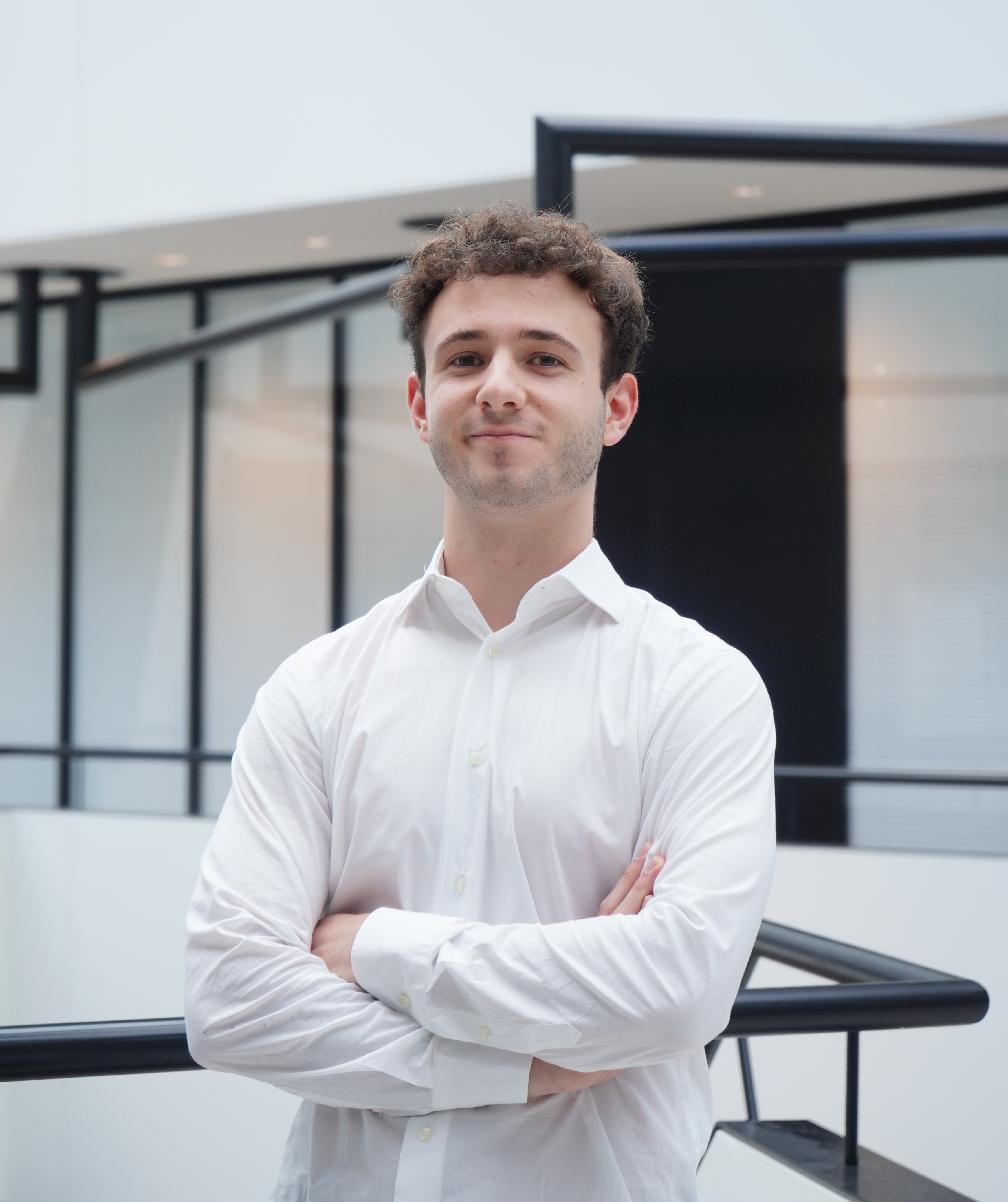
Profile photo of Pablo Sarró Sánchez

Experience

My work experience, academic background and the roles I've taken on alongside them.

Work Experience

Education

Roles & Leadership

Projects

Research and engineering projects, most recent first.

6DoF Pose Estimation with Vision Transformers on the BOP Benchmark

EPFL semester project · Sep 2026 – present

Extending FastPose-ViT, an existing real-time Vision Transformer pipeline for spacecraft pose estimation (published at WACV 2026), to the standard BOP datasets.

Details
  • Integrating the BOP data format and extending the PyTorch dataloader to support multiple objects per image, so the pipeline runs end to end.
  • Running containerised training jobs with Docker and Kubernetes on EPFL's RCP cluster.
  • PyTorch
  • Docker
  • Kubernetes
  • Computer Vision

Cold Diffusion for Weak-Lensing Galaxy-Cluster Maps

EPFL research project, LASTRO · Jul 2026 – Sep 2026

A cold diffusion model that reconstructs and super-resolves simulated weak-lensing maps of galaxy clusters from degraded inputs.

Details
  • Developed and trained the model in PyTorch, recovering high-resolution physical structure from degraded inputs.
  • Reached an MSE of approximately 7.5 × 10⁻⁵ and a Pearson correlation of 0.948 on the reconstruction task.
  • PyTorch
  • Diffusion Models

Speeding Up Galaxy-Cluster Simulations with PINNs

EPFL semester project · Feb 2026 – Jun 2026

Physics-Informed Neural Networks (PINNs) as fast surrogates for computationally expensive galaxy-cluster evolution simulations.

Details
  • Built PyTorch models that embed the governing physical equations into training, reducing reliance on costly numerical solvers.
  • Trained on HPC resources (SLURM, EPFL SCITAS clusters).
  • PyTorch
  • PINNs
  • HPC
  • SLURM

Detectability Transition in Network Alignment

Bachelor's thesis, URV · Sep 2024 – Jun 2025 · Best Bachelor's Thesis

When can the true correspondence between two noisy observations of the same network be recovered from their structure alone? Supervised by Roger Guimerà.

Details
  • Built a Bayesian inference framework using MCMC with parallel tempering to sample the posterior over network alignments.
  • Identified transitions between algorithmic failure and theoretical impossibility of recovery, including regimes where the true alignment is detectable in principle but computationally inaccessible.
  • Analysed these phenomena through statistical physics, studying the posterior landscape and how low-energy configurations relate to the ground truth.
  • Bayesian Inference
  • MCMC
  • Parallel Tempering
  • Statistical Physics

Prizes & Distinctions

CV

My full CV is available on request. Send me an email and I'll be happy to share it with you.

Request my CV

Contact

Feel free to reach out for collaborations, questions, or just to say hi.